Last modified: 2026-09-19 by martin karner
Keywords: efrata | efrat | mo'atza mekomit efrata | judea and samaria |
Links: FOTW homepage |
search |
disclaimer and copyright |
write us |
mirrors
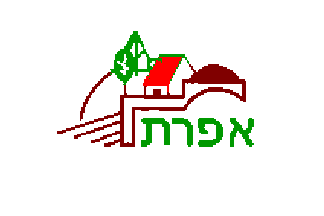 image by Dov Gutterman | 2:3     |
See also:
Local Council Efrata (also known as Efrat) was established in
1983 and its name is taken from the Bible (Derekh Efrata
[Efrata Way/Road] Genesis 35:19 –
the name of the site in which Our Mother Rachel was buried), and thats due to its
position between Bethlehem and Hebron (Judea and Samaria
District). Local Council since 1980 with 7000 inh. (2003).
At www.efrata.muni.il [retrieved]
one can see the municipal emblem and here [not archived],
you can see a photo of the
municipal flag.
The emblem is symbolic and one can see trees, furrows and red-roof
house as well the Tomb of Rachel and inscription.
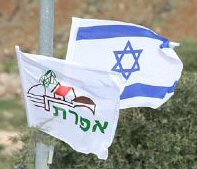
The flag is white and charged with the emblem.
Sources: www.gushnews.co.il [not archived]
Dov Gutterman, 9 April 2005
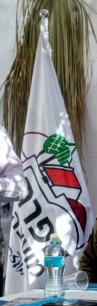 image located by William Garrison
Source:
https://www.jns.org/ [retrieved]
In a more recent photo from September 2021, the flag has black text instead
of green, and more text below.
William Garrison, 28 September 2021
efrat.gif)
(source: municipal website [retrieved])
From the former communal Website (in Hebrew):
The emblem of the Efrat Local Council / Moshe Moskovitz, Head of the Efrat Local Council 1980–1985, one of the founders of the settlement.
Immediately upon the council's establishment, a search began for a coat of arms for the local authority that would reflect the aspirations for the planned town of Efrat.
The coat of arms was presented to the council members, received their approval, and has been in use since the appointment of the first council in 1979.
The chosen emblem is the result of a combination of several ideas and comprises the following elements:The oriental-style dome symbolises Rachel's Tomb, which is located nearby, and the verse 'And the children shall return to their own borders'. Beside it is a modern house with a red roof, symbolising new construction, such as the houses being built in rural settlements across the country. Next to it are the furrows of the Efrat fields and two planted trees, symbolising new planting and the desire to take root once more in the soil of the homeland.
(Translated with DeepL.com)