
Last modified: 2026-06-06 by rob raeside
Keywords: sardinia |
Links: FOTW homepage |
search |
disclaimer and copyright |
write us |
mirrors
See also:
The blazons below are presented together in the 1805 edition of Carta de
Logu, the medieval Sardinian/Arborean legal code which was promulgated in
1392 by Judgess Eleonora of Arborea, to be promulgated again in 1421 by King
Alfonso V of Aragon as the legal code for whole Sardinia, remaining in force
until 1827 [1, 2, 3]. There, four armorial bearings are arranged in a
pseudo-heraldic composition, each accompanied with the appropriate title in
Latin [1]. This reveals that the arms, even if they did not exist, were already
attributed to the judicates before the book was published, probably for a long
time. Unfortunately, the black and white print, which did not employ hatching,
does not allow for the reconstruction of colors, which might then remain unknown
if no other sources exist.
Sources:
[1] Wikimedia Commons - Arms of
Sardinian Judicates in the 1805 edition of Carta de Logu:
https://commons.wikimedia.org/w/index.php?title=File:Le_costituzioni_di_Eleonora_d%27Arborea.pdf&page=7
[2] Carta de Logu at Wikipedia (in English):
https://en.wikipedia.org/wiki/Carta_de_Logu
[3] Carta de Logu
at Wikipedia (in Italian):
https://it.wikipedia.org/wiki/Carta_de_Logu
Tomislav Todorovic, 17 May 2026
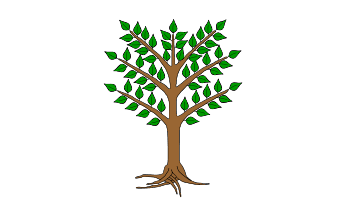 image sourced by António Martins-Tuválkin, 24 April 2026
At Progetu Repùblica de Sardigna M. Schmöger states that a green tree (all green) flag was adopted by the party, in reference to the arms of the Giudicato di Arborea. At https://en.wikipedia.org/wiki/Judicate_of_Arborea this is given a deeper treatment. Thereat, and also in its Italian language equivalent and source (https://it.wikipedia.org/wiki/Giudicato_di_Arborea), a flag image illustrates the article’s infobox. That might be an anachronic fabrication, or maybe not – either way, here's from Wikimedia Commons (https://commons.wikimedia.org/wiki/File:Flag_of_the_Giudicato_of_Arborea.svg) an image co-credited to Wikimedia users The White Lion, Fabiocarboni, and Facquis.
This flag is not mentioned in https://www.rbvex.it/indice.html so it may be likely fictitious or a historical item.
António Martins-Tuválkin, 24 April 2026
The has been proposed as a flag of Sardinia, Italy, as a way to get rid of
the flag with the four Moor heads. An explanation can be seen at
https://www.sardiniapost.it/politica and there is a book about it (https://www.facebook.com/p/La-vera-storia).
The emblem at the center of the flag is also used by pro-independence parties in
Sardinia.
https://it.wikipedia.org/wiki/Bandiera_arborense and
https://www.isimbolidelladiscordia.it/2024/01/lalbero-della-discordia-in-sardegna.html
Zachary Harden, 12 March 2025
The flag of Arborea is listed there in the alphabetical index, the A letter
page:
https://rbvex.it/interpag/alfabeta.html and presented among the Italian
historical flags:
https://rbvex.it/italiantica.html#arbor.
However, the tree is
described there as all green, not proper as presented at Wikimedia Commons. The
cited source is Pino Saborito, a 14th century chronicler and contemporary of
Mariano IV, Judge of Arborea (reigned 1347-1376) who had brought nearly whole
Sardinia under his rule, being the only native ruler to do so, the fact which
must have inspired the promoters of this design for the Sardinian flag.
On the other hand, "argent a tree proper" is the coat of arms of the province of
Oristano, clearly adopted in order to commemorate the
fact that the city of Oristano, provincial capital, was also the capital of
Arborea. Beside the gonfalon, the province also uses the flag, white with the
complete arms:
https://rbvex.it/province/sud/sardegna.html#or
The flag is
incompletely visible in this photo:
https://commons.wikimedia.org/wiki/File:Province_of_Oristano_headquarters.jpg
as well as in the video @0:00-0:04 and @0:58-1:03, while the close view of the
gonfalon is available @0:05-0:07, @0:29-0:49 and @0:54-0:58:
https://www.videolina.it/articolo/tg/2024/12/14/oristano_i_50_anni_della_provincia_programmazione_per_il_futuro-78-1207509.html
These sources reveal that in the arms, the tincture argent is
represented as a light shade of gray.
Tomislav
Todorovic, 24 April 2026
Excellent find! That justifies the inclusion of this flag in both mentioned
Wikipedia articles. Interestingly, Roberto Breschi (noted vexillologist and
author of RBVex.IT) references the same book already mentioned by Tomislav –
Franciscu Sedda’s La vera storia della bandiera dei sardi, Condaghes:
Cagliari, 2007, soon in our Bibliography as [sfu07].
At https://rbvex.it/italiantica.html#arbor one further reads:
l'arma del giudicato, evidentemente "parlante" così come quelle di altri giudicati: la torre per Torres e il gallo per Gallura (Cagliari aveva il cavallo).Which means that the arms of Arborea are evidently canting as also those of other judicates: The tower of Torres and the rooster of Gallura, while Cagliari had a horse. No word about any flag of these three, though, which also explain why the three coordinated flag images for them in Wikimedia Commons – all drawn by the same original authors as rectangular white oblong flags with each judicate’s arms centered on it – were not used in the respective Wikipedia articles. These are, for the record:
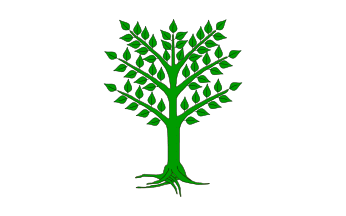 image by Tomislav Todorovic, 17 May 2026
derived from
hhttps://commons.wikimedia.org/wiki
Plain ~5:8 white flag with an image of a leafed tree proper.
António Martins-Tuválkin, 26 April 2026
The origins of the arms of Arborea are described in the essay Aristanis. La
nascita dello stemma giudicale d Arborea by Foiso Fois, which was published
in the book Quattro note storiche per lo Stemma della Provincia di Oristano
by Giuseppe Pau. The text can be found here:
https://www.facebook.com/groups/3727227613991593/posts/24626833386937711
There, the earliest depictions of the tree as the symbol of Arborea are said
to date from the time of Judge Mariano II (reigned 1241-1297), when it was the
central element of the seal, accompanied with the inscription Sigillum regni
Arborensis. In the 1910 text by Canon Antioco Melis, which was cited there,
the tree was said to be a pine tree and depicted as eradicated because "Arborea
did not originate from anyone but formed by itself".
In the 1805 source
illustration (see above), the tree of Arborea is depicted as growing from a
base, looking almost like a landscape, which was frequently done with the
contemporary depictions of numerous arms, even if it was actually contrary to
the blazon, so it can be safely ignored in this case. The model for the present
day reconstruction is the relief from San Serafino Church, Ghilarza, Oristano
Province:
https://it.wikivoyage.org/wiki/File:Stemma_giudicato_Arborea_Ghilarza.jpg
Regarding the colors, the tree proper does appear in the arms of the
province of Oristano, but the contemporary sources describe
the tree of Arborea as all green, which is why it should be depicted as such.
Tomislav Todorovic, 17 May 2026
Speculative
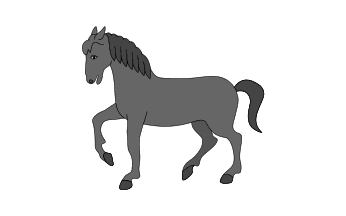 image sourced by António Martins-Tuválkin, 26 April 2026
A putative banner of arms of Cagliari, made from https://commons.wikimedia.org/wiki/File:Coat_of_arms_of_Judicate_of_Cagliari.svg by Facquis: Argent a horse pssant Gris maned and hoofed Sable (?).
António Martins-Tuválkin, 26 April 2026
The unusual combination of Gris as the main tincture and Sable as the tincture
for details is most likely an error - the horse is probably meant to be all
Sable, but the creator from Wikimedia Commons must have been worried that no
details would be visible, unlike the creator of the image of the arms presented
at WappenWiki:
https://wappenwiki.org/index.php/Giudicato_of_Cagliari
There, the
horse is clearly all Sable and while, strictly speaking, only the outlines are
truly black, the color of the horse is so dark that it can pass for black.
Whether the horse should really be passant, is a matter of discussion: the
1805 source illustration (see above) actually displays a demi-horse for
Cagliari, which might suggest a horse rampant, but nothing certain can be said
about that until some contemporary sources are discovered.
Tomislav Todorovic, 17 May 2026
Speculative
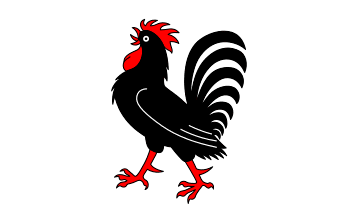 image sourced by António Martins-Tuválkin, 26 April 2026
A putative banner of arms of Gallura, made from https://commons.wikimedia.org/wiki/File:Gallo_del_Giudicato_di_Gallura.svg by Fabiocarboni: Argent a rooster Sable armed and crested and barbed Gules.
António Martins-Tuválkin, 26 April 2026
In the 1805 source illustration (see above), the rooster of Gallura is depicted
as standing on a base, which gives the impression of a landscape, as was
frequently done with the contemporary depictions of numerous arms, even if it
was actually contrary to the blazon, so it can be safely ignored in this case,
especially considering that the contemporary presentations of the arms exist, in
form of the reliefs [1, 2]. Moreover, the rooster of Gallura is mentioned by
Dante in his Purgatorio, canto VIII, verses 79-81, where the poet
describes the meeting with his deceased friend, Judge Nino (Ugolino) of Gallura
(reigned 1275-1296) who, speaking of his widow Beatrice d'Este, who had
remarried to Galeazzo I Visconti, duke of Milan, says that "the viper that forms
the arms of the Milanese will not adorn her tomb as beautifully as the rooster
of Gallura would have" [2, 3].
This reconstruction of the banner of arms
of Gallura employs the colors which were used in the arms of the 2005-2016
province of Olbia-Tempio [4]. Since 2021, the same quarter has appeared in the
arms of the province of Gallura Nord-Est Sardegna [5].
Sources:
[1] Vulcano Notizie website:
https://www.vulcanonotizie.it/la-gloriosa-storia-dei-regni-giudicali-sardi-un-frammento-della-nostra-storia-quasi-sconosciuto
[2] Summa Gallicana website:
https://www.summagallicana.it/Emblemata/Emblemi/Italia/Giudicato_di_Gallura.htm
[3] Judge Nino of Gallura at Wikipedia:
https://en.wikipedia.org/wiki/Nino_Visconti
[4] Roberto Breschi's
website - Province of Olbia-Tempio:
https://rbvex.it/province/sud/sardegna.html#ot
[5] Province of Gallura
Nord-Est Sardegna - Official website:
https://www.provinciagallura.it
(image:
https://www.provinciagallura.it/logo.jpg)
Tomislav Todorovic, 17 May 2026
Speculative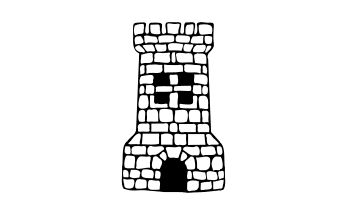 image sourced by António Martins-Tuválkin, 26 April 2026
A putative plain ~5:8 white flag with an image of a tower centered on it, depicted with white stonework pointed in black, door and window also black, embattled at the top.
António Martins-Tuválkin, 26 April 2026
The reliefs depicting the arms of the Judicate can be found on the buildings
in the area, such as the Basilica of St Gabinus in Porto Torres [1] and the
Cathedral of St Nicholas in Sassari [2]. These, just like the 1805 source
illustration (see above), reveal nothing about the actual colors, which might be
not known at all, considering that various combinations are employed by the
derived arms: Argent upon Azure by the municipality of Porto Torres [3], Gules
upon Or by the municipality of Sassari [3] and Or upon Gules by the province of
Sassari [4].
Sources:
[1] Wikimedia Commons - Arms of the Torres
Judicate, Basilica of St Gabinus, Porto Torres:
https://commons.wikimedia.org/wiki/File:Stemma_torres_198.jpg
[2]
Wikimedia Commons - Arms of the Torres Judicate, Cathedral of St Nicholas,
Sassari:
https://commons.wikimedia.org/wiki/File:Sassari_-_Torre_del_Logudoro.jpg
[3] Roberto Breschi's website - Cities of Sardinia:
https://rbvex.it/province/comunali/sardegnacitta.html
[4] Roberto
Breschi's website - Province of Sassari:
https://rbvex.it/province/sud/sardegna.html#ss
Tomislav Todorovic, 17 May 2026


