
Last modified: 2025-12-06 by  zachary harden
Keywords: star: 5 points (white) | arrowhead | triangle (black): hoist | asean |
Links: FOTW homepage |
search |
disclaimer and copyright |
write us |
mirrors
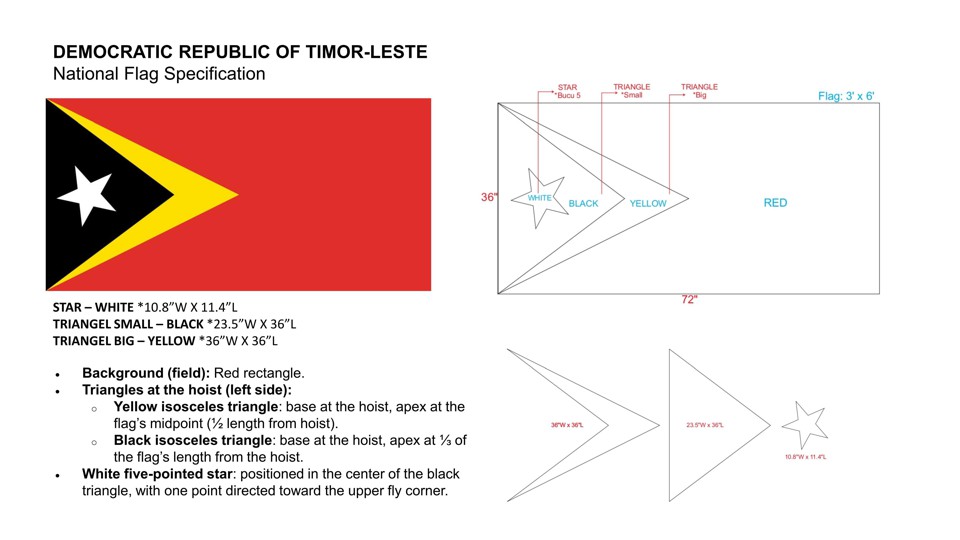 image located by Zachary Harden, 30 October 2025
With the news of Timor-Leste joining the ASEAN organization a few days ago, there was some talk before about the changing of the ASEAN emblem or flag. That did not happen so far and I found no evidence so far. But....
We probably have the most definitive specification of the Timor-Leste flag that we could find.
"How?"
Each member of ASEAN deposits their flag specifications with their protocol division, and these specifications are uploaded on to the ASEAN member profile. In the case of Timor-Leste, it can be found here (main page https://asean.org/timor-leste/ ). Now, some of these specifications [the ASEAN website have] are the same (Brunei, Malaysia), some are different from what we have from governments (Thailand, mostly based on colors). However, what we have here from Timor-Leste is different from what we found in the legislation already presented (https://www.crwflags.com/fotw/flags/ ), but also the UN transition flag we [already cover].
Zachary Harden, 30 October 2025
Now, for the ratio; it is confirmed to be 1:2. This is something we saw from the UN, but not from legislation. For the two triangles, the ASEAN document says the following:
"• Triangles at the hoist (left side): o Yellow isosceles triangle: base at the hoist, apex at the flag’s midpoint (1/2th length from hoist). o Black isosceles triangle: base at the hoist, apex at 1/3rd of the flag’s length from the hoist." This confirms the legislation we have; however, the black triangle is larger than the UN design as they had it as 1/4th of the length.
The star, as per the ASEAN document: "• White five-pointed star: positioned in the center of the black triangle, with one point directed toward the upper fly corner." This confirms everything in the terms of the direction, placement, and the star style. The only (slight) difference is the size. The sample size that the ASEAN document used for this flag was 36x72 inches (3x6 feet); the star size according to them is *10.8”W X 11.4”L. The UN document had it as 29 cm (from point to point) and, with a conversion from cm to inches, it shows 11.4173 inches. However, the ASEAN document does not indicate any circumference with regard to the star.
Colors: The ASEAN document has the following:
| Each member of ASEAN deposits their flag specifications with their | protocol division, (...) | Now, some of these specifications are the same (Brunei, Malaysia), | some are different from what we have from governments (Thailand, | mostly based on colors).
This should be a huge red flag (pun intended!), though we should by now
be aware how much these specifications issued by goverments are all but
useless, for the most part. They’re surely an interesting vexillological
subject on themselves — on how the same country (or other entity) will
issue conflicting specs, on how those published specs contradict actual
official flag use, and on how the specs themselves end up prescribing
details that are not the intended ones (cue in the impossible geometry
or Alabama or Nepal, the brown/green flag of Spain, or the officially
different shades of blue and red for Australia and New Zealand). Are
these specs useful to create reference quintessential images of flags?
Do they, in general, put to rest perennial doubts such as the ratios of
Niger, Cape Verde, or Gabon? Sadly, they do not. The flag specs communicated by the TL government to the ASEAN conflict
with the constitutional prescription? So, it means they are just wrong,
right? Unsurprisingly, since the 2002 UNTAET flag spec was a deplorable show of
incompetence. The whole point of official specs would be to clarify this kind of basic
distinction: Even if the discerning vexillologist knows there’s little
use in faffing over minor color shade differences, however specified
(the mentioned discrepance in AU and NZ’s official specs illustrates
this very point), the difference between R and R+ is crucial — as Zach’s
mention of DK reds very aptly foreshadows.
António Martins-Tuválkin, 31 October 2025
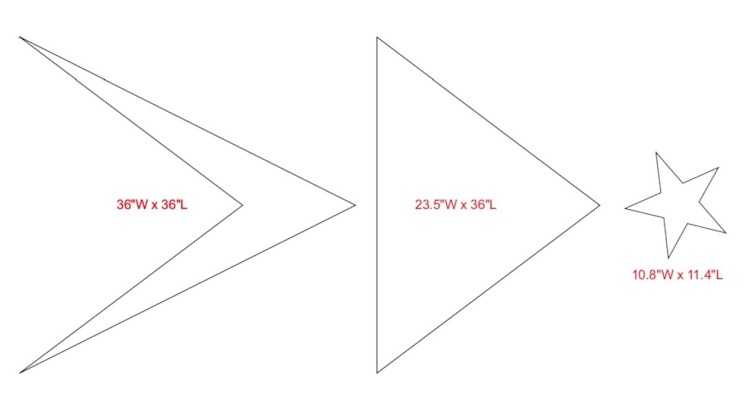 image located by Zachary Harden, 30 October 2025
| The star, as per the ASEAN document:
|
| "• White five-pointed star: positioned in the center of the black
| triangle, with one point directed toward the upper fly corner." This
| confirms everything in the terms of the direction, placement, and
| the star style. The only (slight) difference is the size.
Zach, I cannot see where the text indicates the size of the star. I take
it that the star measurements are sourced only from the image, right? [yes]
| The sample size that the ASEAN document used for this flag was 36×72
| inches (3×6 feet); the star size according to them is *10.8”W × 11.4”L.
That’s meant as the width and “length” of the bounding box around the
already rotated star? Hmm, not a very useful spec, geometry-wise (we’ve
seen the same in the official specs of the newest D.R.C. flag, but those
are upright, at least, making determination of the actual radii of the
stars less awkward).
| The UN document had it as 29 cm (from point to point) and,
| with a conversion from cm to inches, it shows 11.4173 inches.
Is 29 cm for the star’s diagonal a match for the inches given for the
bounding box of the rotated star? Is the actual rotation angle even
exactly knowable, given that it is the star, and not its enscribing
circle, that is said (or merely implied?) to be centered on the black
triangle?
António Martins-Tuválkin, 31 October 2025